
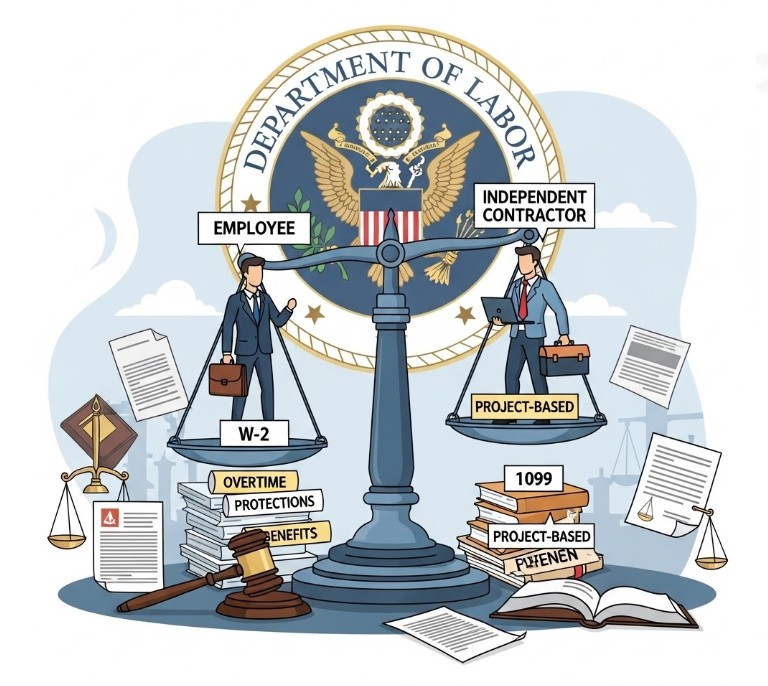
On February 26, 2026, the Department of Labor (DOL) introduced a Proposed Rule aimed at redefining the boundaries between employees and independent contractors. This update marks a pivot away from current standards, moving toward a framework that mirrors the 2021 “employer-friendly” guidelines. Notably, the DOL intends to apply this classification logic not just to the FLSA, but also to the FMLA and MSPA.
The Return of the “Economic Reality” Test
The heart of this proposal is a shift back to the “economic reality” model. While the 2024 rule utilized a broad “totality of the circumstances” approach—which often led to more workers being labeled as employees—the new proposal simplifies the analysis.
The DOL now intends to prioritize two primary “core factors” to determine status:
- Control: The level of authority a worker has over their own tasks and schedule.
- Financial Risk/Reward: Whether the worker has a genuine opportunity for profit (or a risk of loss) based on their own business investments or initiative.
If both of these factors suggest the same classification, that result will likely stick. Other considerations—such as the worker’s skill level, the length of the relationship, and how integral the work is to the business—will serve as guidance rather than primary drivers. Actual practice will matter more than what may be in a contract.
Essential Realities for Employers
The Proposed Rule offers potential relief for industries heavily reliant on contractors by providing a clearer path to independent classification. However, several nuances remain:
- Action Over Paperwork: The DOL will look at how the relationship functions in practice, not just what is written in a contract. Interestingly, requiring a worker to follow safety protocols or meet deadlines will not automatically turn them into an employee under this rule.
- A Patchwork of Laws: This proposal only changes the federal DOL landscape. Employers must still navigate different standards set other federal agencies and individual states.
- Liability Remains High: Misclassifying staff still carries heavy penalties.
Timeline and Strategy
The public has until April 28, 2026, to comment on these changes. Until a final version is published and takes effect, the 2024 Final Rule remains the law of the land.
Recommended Next Steps:
- Audit Current Staffing: Review existing contractor agreements against the “core factors” of control and financial opportunity.
- Check Local Compliance: Ensure your classifications hold up under state-specific laws, which are often stricter than the federal DOL standard.
- Stay Informed: Watch for the final version of the rule following the public comment period this spring.
If you have questions about employing independent contractors, or concerns regarding proper classification of independent contractors, you can reach us at https://martinkreshon.com or call (206) 929-0609. You can also find reviews for Martin on Google and Avvo.