
Author: Martin Kreshon
-
Washington Expands Fair Chance Protections for Workers with Criminal Records
Washington’s Fair Chance Act has limited when employers can ask about criminal history since 2018. But 2025 amendments to the law go further. Enacted as EHB 1747, the changes do not replace the original law so much as expand it: the earlier statute focused mainly on when employers could seek criminal-record information, while the amendments…
-
Are You Registered to Hire Remote Workers in Washington?
An out-of-state company hires a software developer who lives in Washington and works from home. Does that single remote employee hire mean the company is doing business in Washington? Must it register with the Secretary of State? However, as of 2026, the Legislature answered the Remote employee registration portion. It left the tax half open.…
-
Noncompetes Were Already Getting Harder to Enforce: David v. Freedom Vans
Washington’s 2026 ban on noncompetes did not come out of nowhere. Even before it passed, Washington courts and the 2019 noncompete statute were steadily narrowing what employers could enforce. The Washington Supreme Court’s 2025 decision in David v. Freedom Vans, 4 Wash.3d 242 (2025) (En Banc) is a useful marker of that trend—and a preview…
-
What Still Works After the Noncompete Ban: Nonsolicitation, Confidentiality, and the Sale-of-Business Exception
Washington’s ban on noncompetes (Chapter 149, Laws of 2026) does not leave employers with nothing. It preserves a short, narrowly drawn set of protections. The catch is that each one is defined tightly, and the statute tells courts to construe these exceptions narrowly. Here is what survives after June 30, 2027—and where the traps are.…
-
Washington Just Voided Almost Every Noncompete Agreement
Washington has taken its 2019 restrictions on noncompetes to their logical conclusion: a near-total ban. Under ESHB 1155 (Chapter 149, Laws of 2026), signed March 23, 2026 and effective June 30, 2027, virtually every noncompetition covenant with a Washington worker becomes void and unenforceable. This is one of the most significant changes to Washington employment…
-
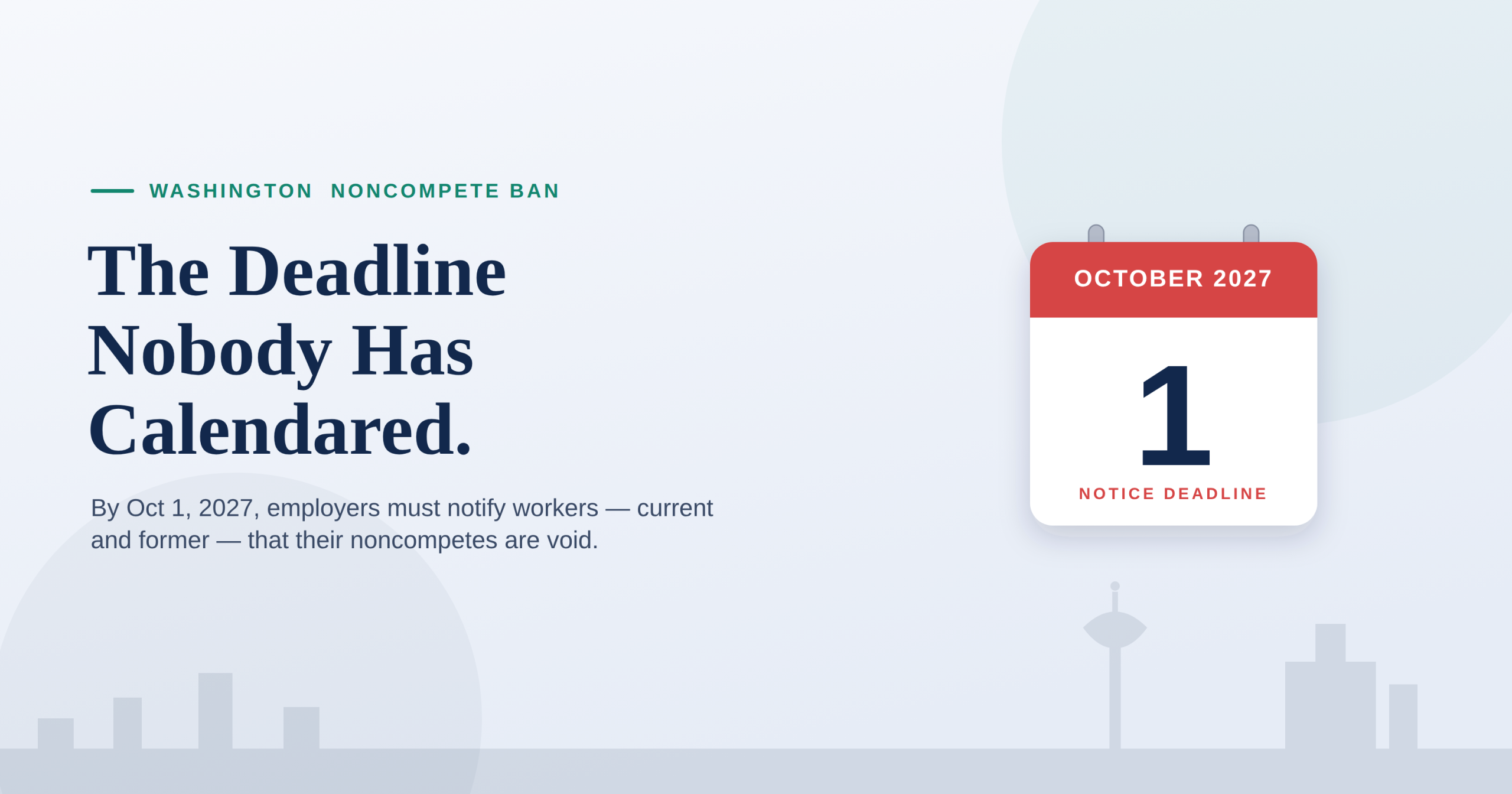
The Noncompete Notice Cliff – Don’t Fall October 1, 2027
Washington’s non-compete ban comes with an affirmative duty most employers have not yet put on the calendar. It is not enough to stop enforcing noncompetes—by a fixed date, employers must proactively tell affected workers that their covenants are dead. The requirement The enacted law, amending chapter 49.62 RCW, provides that by October 1, 2027, an…
-
Washington’s 2027 Paid Leave Premium Update
Alongside the minimum wage, the other year-end number Washington employers need is the Paid Family & Medical Leave (PFML) premium rate. The Employment Security Department (ESD) resets it annually, and the 2027 rate will be announced later this fall. How the premium is set PFML is funded by a premium assessed on employee wages up…
-
Washington’s 2027 Minimum Wage: What to Expect
Every fall, Washington employers get one number they cannot plan payroll without: the next year’s minimum wage. Here is what is coming, when, and why it also quietly resets a second threshold that catches salaried employers off guard. The mechanics of the annual increase Washington’s minimum wage is adjusted for inflation every year. Under the…
-
Your Bonus Clawback Is Now a Noncompete
The most overlooked part of Washington’s new noncompete ban is that it does not only target clauses labeled “noncompete.” It reaches a whole category of compensation provisions that most employers never think of as noncompetes at all—forfeiture clauses, bonus clawbacks, and “stay-or-pay” arrangements. The expanded definition Under the enacted law amending chapter 49.62 RCW, a…
-
Washington Employers Get New I-9 Inspection Notice Duties
Washington enacted a new Immigrant Worker Protection Act this year, and its employer-facing duties are scheduled to take effect on October 1, 2026. The law was passed as 2SHB 2105 (Chapter 240, Laws of 2026), a bill requested by the Attorney General. What makes it worth flagging now is that it applies to essentially every…