
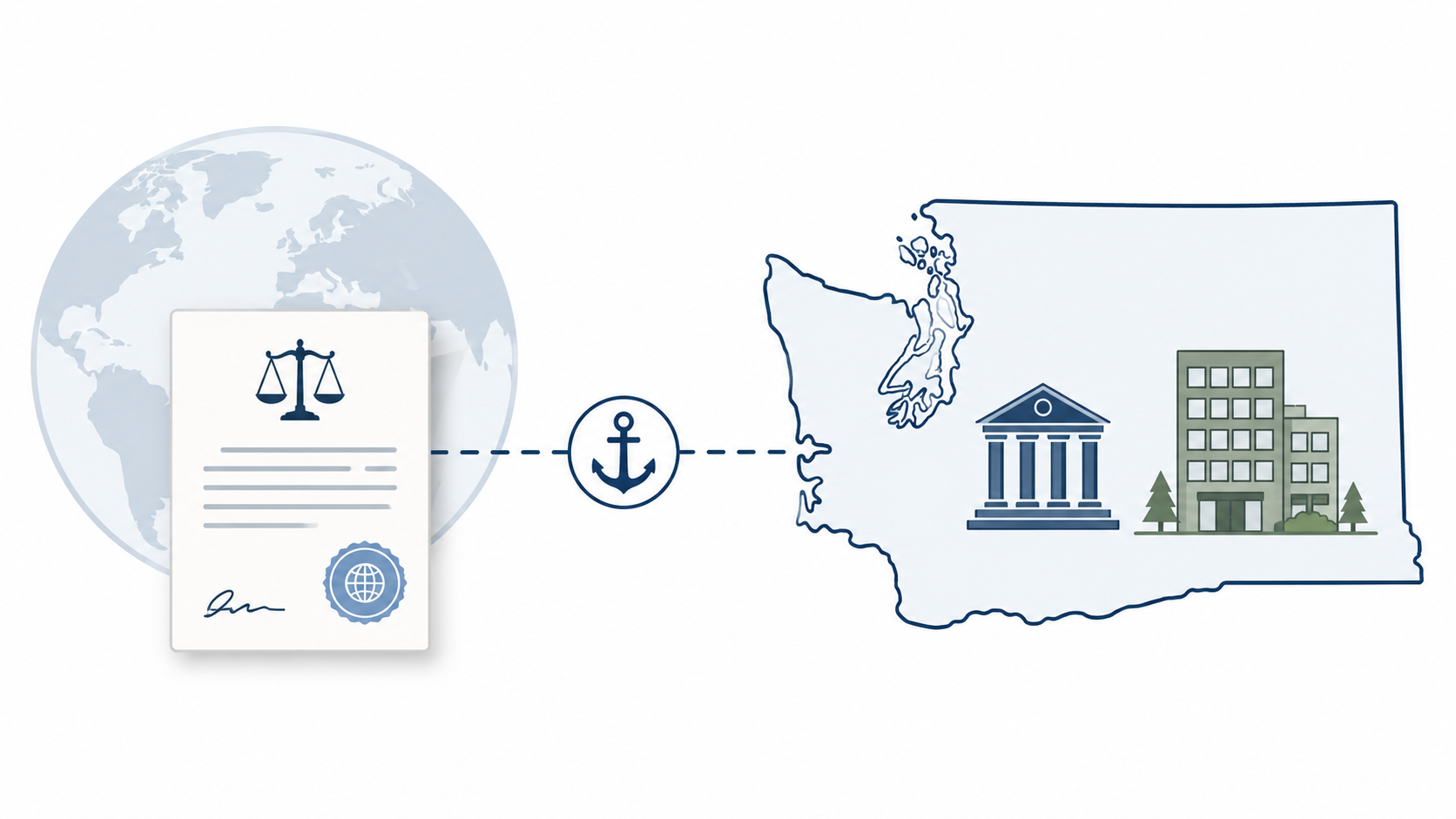
In Alterna Aircraft V B Ltd. v. SpiceJet Ltd., the Washington Supreme Court held that a creditor seeking recognition of a foreign-country money judgment must identify Washington property if there is no general or specific jurisdiction over the debtor here.
What Happened
Washington has adopted the Uniform Foreign-Country Money Judgments Recognition Act, which allows certain foreign-country money judgments to be recognized and then enforced like Washington judgments. But recognition is still an exercise of judicial power, and jurisdiction still matters.
In Alterna Aircraft V B Ltd. v. SpiceJet Ltd., the Washington Supreme Court addressed whether a judgment creditor can seek recognition in Washington when the debtor is not otherwise subject to general or specific jurisdiction in the state. The court said no. In that situation, the creditor must establish that the debtor has property in Washington.
The court reversed and remanded, making clear that the presence of Washington property is the jurisdictional hook that can keep this kind of recognition action in Washington when there is no other basis for personal jurisdiction.
Why It Matters
The decision matters to international lenders, aircraft and equipment lessors, cross-border suppliers, and any business that might need to enforce a foreign judgment in the United States. It narrows the idea that Washington can serve as a convenient recognition forum simply because a creditor prefers to sue here.
The ruling is also a reminder that enforcement strategy should begin before judgment, not after it. Contracting parties often focus on forum-selection clauses and dispute resolution rules, but post-judgment collection planning matters too. If Washington might be the target forum later, businesses should think early about whether the counterparty has assets here or a more direct connection to the state.
For Washington companies on the receiving side of foreign judgment actions, the case is equally important. It reinforces that the state’s courts are not available for recognition proceedings unless ordinary jurisdictional limits are satisfied.
What Businesses Should Do Now
- Before filing in Washington, investigate whether the debtor has identifiable property in the state and gather admissible evidence about that property.
- When negotiating international contracts, think beyond the merits forum and plan for where a judgment could realistically be recognized and enforced.
- Coordinate foreign counsel and U.S. counsel early so post-judgment enforcement options are mapped before assets move or disappear.
- Do not assume that a large business relationship with Washington companies automatically creates the necessary Washington jurisdiction.
If you have questions or need help domesticating a foreign judgment, you can reach us at https://martinkreshon.com or call (206) 929-0609. You can also find reviews for Martin on Google and Avvo.