
Tag: compliance
-
The Federal Definition of Hemp Just Changed: What the New THC Limits Mean for Your Business
If your business grows, extracts, manufactures, distributes, or sells hemp-derived cannabinoid products, the ground just shifted. Congress rewrote the federal definition of hemp, and the change is phasing in right now. Products that were legal hemp can become marijuana under federal law on a fixed date, with consequences that reach well beyond a product label.…
-
A Stock Sale Taxed Like an Asset Sale: Section 338 and 336(e) Elections
In most business sales, buyer and seller start on opposite sides of a single question: asset deal or stock deal? Buyers usually want to buy assets—they get a stepped-up tax basis and can leave unwanted liabilities behind. Sellers usually prefer to sell stock—one level of tax, and mostly capital gain. But sometimes a stock sale…
-
Your Crew Worked Two Hours in Seattle. Do You Owe $21.30 an Hour?
A landscaping crew based in Shoreline drives into Seattle for a half-day job. A Bothell electrician spends a morning on a Seattle site. In both cases, the employer may owe Seattle’s minimum wage—not Washington’s—for the hours worked inside the city. For 2026 that is a meaningful gap: Seattle’s minimum wage is $21.30 per hour, against…
-
Formed Before August 1, 2024? You Still Need a Two-Thirds Vote to Dissolve a Corporation
Washington modernized its business corporation act, and one change quietly split corporations into two groups based on when they were formed. The dividing line—August 1, 2024—determines how large a shareholder vote you need to voluntarily dissolve. If your corporation predates that date, the old two-thirds supermajority still applies unless you take action. The two-track rule…
-
Washington Is Already Walking Back Parts of Its New Service Sales Tax
In late 2025, Washington reclassified a long list of services as taxable retail sales. Less than a year later, the Legislature began narrowing that expansion. If you restructured contracts or pricing to deal with the 2025 change, some of those assumptions have already shifted. What 2025 did Under ESSB 5814 (Chapter 422, Laws of 2025),…
-
Are You Registered to Hire Remote Workers in Washington?
An out-of-state company hires a software developer who lives in Washington and works from home. Does that single remote employee hire mean the company is doing business in Washington? Must it register with the Secretary of State? However, as of 2026, the Legislature answered the Remote employee registration portion. It left the tax half open.…
-
Noncompetes Were Already Getting Harder to Enforce: David v. Freedom Vans
Washington’s 2026 ban on noncompetes did not come out of nowhere. Even before it passed, Washington courts and the 2019 noncompete statute were steadily narrowing what employers could enforce. The Washington Supreme Court’s 2025 decision in David v. Freedom Vans, 4 Wash.3d 242 (2025) (En Banc) is a useful marker of that trend—and a preview…
-
What Still Works After the Noncompete Ban: Nonsolicitation, Confidentiality, and the Sale-of-Business Exception
Washington’s ban on noncompetes (Chapter 149, Laws of 2026) does not leave employers with nothing. It preserves a short, narrowly drawn set of protections. The catch is that each one is defined tightly, and the statute tells courts to construe these exceptions narrowly. Here is what survives after June 30, 2027—and where the traps are.…
-
Washington Just Voided Almost Every Noncompete Agreement
Washington has taken its 2019 restrictions on noncompetes to their logical conclusion: a near-total ban. Under ESHB 1155 (Chapter 149, Laws of 2026), signed March 23, 2026 and effective June 30, 2027, virtually every noncompetition covenant with a Washington worker becomes void and unenforceable. This is one of the most significant changes to Washington employment…
-
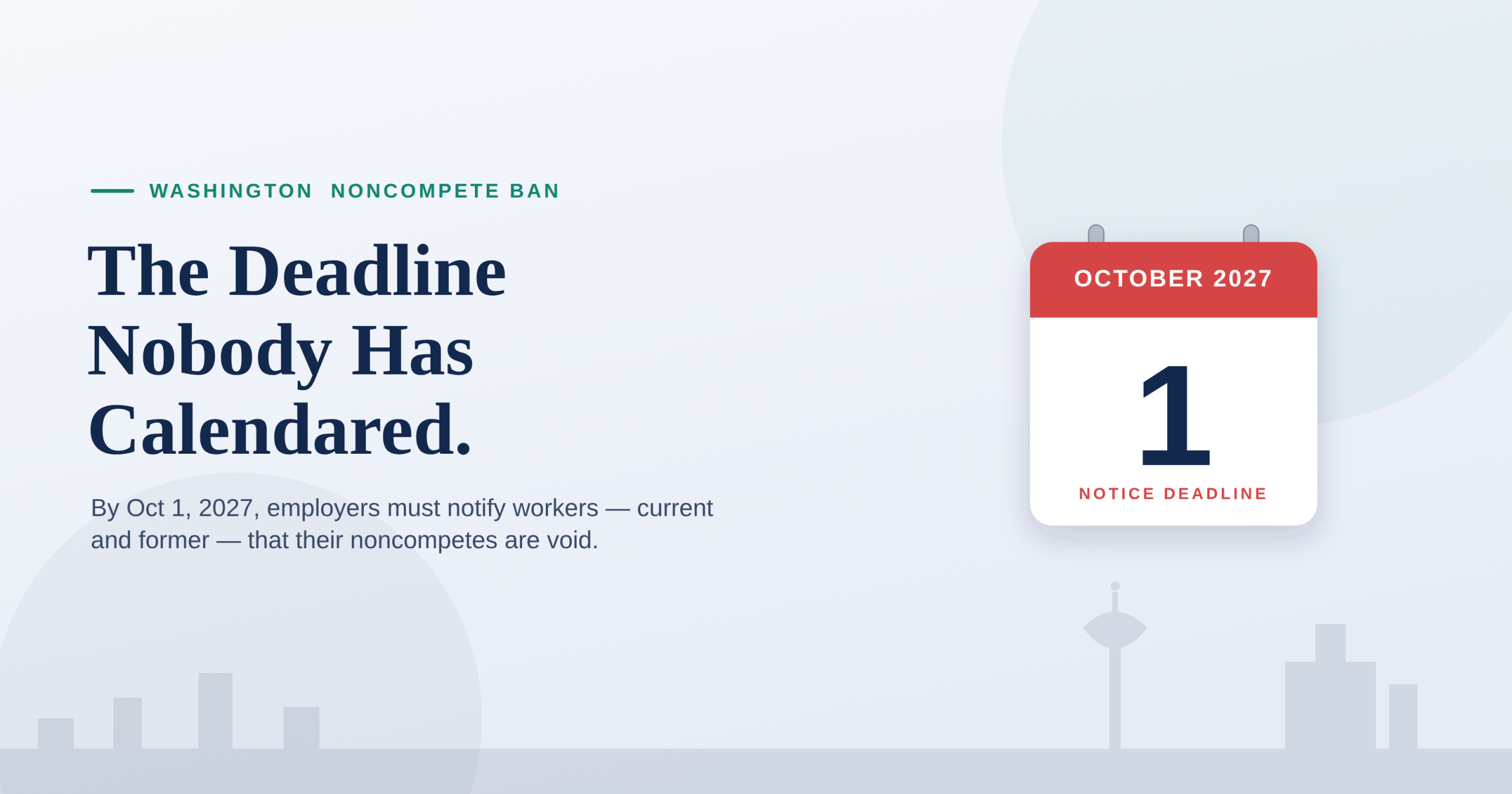
The Noncompete Notice Cliff – Don’t Fall October 1, 2027
Washington’s non-compete ban comes with an affirmative duty most employers have not yet put on the calendar. It is not enough to stop enforcing noncompetes—by a fixed date, employers must proactively tell affected workers that their covenants are dead. The requirement The enacted law, amending chapter 49.62 RCW, provides that by October 1, 2027, an…