
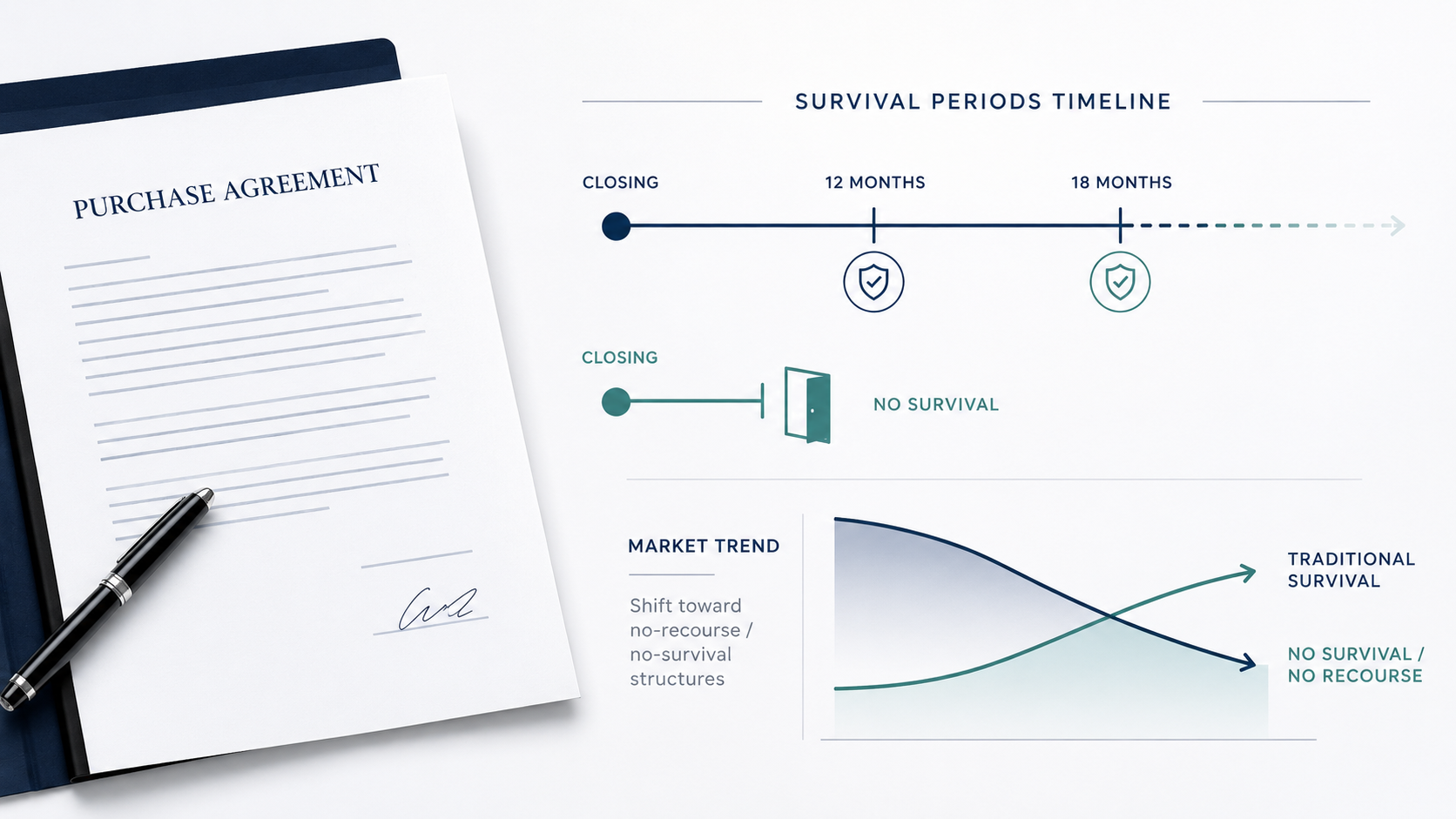
In the high-stakes arena of M&A, the survival period—the window during which a buyer can bring claims for breaches of representations and warranties—is a primary lever for risk allocation. The 2025 ABA Deal Points Study reveals a market increasingly defined by a binary choice: traditional indemnification or the “public-style” no-survival model.
The Decline of Express Survival
Historically, private M&A deals almost always included “express survival” periods. However, the 2025 study shows that “express survival” appeared in only 59% of deals, while “express no survival” (where representations terminate at closing) reached 41%. This shift should be read alongside the continued prevalence of Representation and Warranty Insurance (RWI), although the study does not identify RWI as the sole cause. In deals that reference RWI, 46% made RWI the buyer’s sole source of recovery for all representations, and 28% did so only for non-fundamental representations. That is a recovery-source data point, not the same as express no survival.
Standard Durations for Survivors
For the 59% of deals with express survival, 12-month and 18-month periods remained the dominant general survival periods:
- 12 Months: This was the most common duration, appearing in 46% of deals with express survival.
- 18 Months: Utilized in 40% of deals with express survival, also a common duration.
- 24 Months and Beyond: Only 7% of deals with express survival used a 24-month period, and 3% went beyond 24 months.
The Importance of Carve-Outs
Even when a general survival period is short, many agreements with express survival include “carve-outs” for fundamental representations and other specified claims that survive longer—often until the expiration of the statute of limitations. Among deals with express survival, the 2025 study reports the following carve-outs to survival limitations:
- Fraud: Carved out in 91% of deals.
- Due Authority and Due Organization: Each was carved out in 89% of deals.
- Taxes: Carved out in 73% of deals.
- Capitalization: Carved out in 66% of deals.
Strategic Insight
For sellers, the goal is often a cleaner exit through a 12- or 18-month general survival period, express no survival, or an RWI-as-sole-source structure. For buyers, the focus has shifted toward ensuring that the “fundamental” carve-outs are broad enough to cover catastrophic risks like tax liabilities or ownership disputes, even if the general reps expire quickly.
If you have questions or need help buying or selling a business, you can reach us at https://martinkreshon.com or call (206) 929-0609. You can also find reviews for Martin on Google and Avvo.